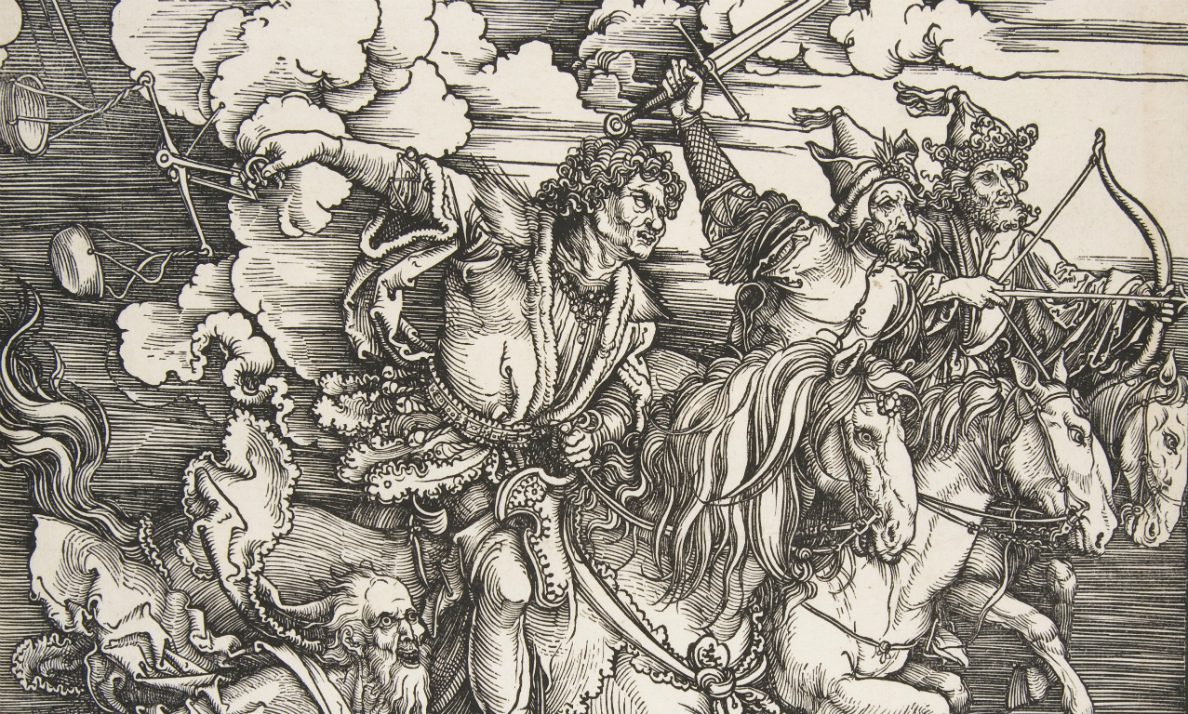
Few images in Western art strike with the same immediacy and ferocity as Albrecht Dürer’s The Four Horsemen of the Apocalypse. Created in 1498, on the threshold of a new century and amid widespread eschatological anxiety, the woodcut remains one of the most iconic visual interpretations of the Book of Revelation. Its power lies not only in its theological subject matter but in Dürer’s unmatched ability to compress motion, symbolism, and dread into a single, explosive composition.
A World on the Brink: The Context of 1498
Dürer produced his Apocalypse series at a moment when Europe was gripped by uncertainty. The year 1500 loomed large in the medieval imagination, often associated with the end of days. Political instability, outbreaks of plague, and the slow but seismic shifts of early modernity created a cultural atmosphere ripe for apocalyptic thinking.
Into this world, Dürer released a book unlike anything seen before: a fully illustrated edition of the Apocalypse, with woodcuts so dramatic and technically advanced that they elevated the medium to new artistic heights. Among these, The Four Horsemen stands as the most dynamic and terrifying.
A Composition That Feels Like a Charge
Dürer’s woodcut depicts the four riders described in Revelation 6—Conquest, War, Famine, and Death—but he does something radical: he compresses them into a single diagonal surge, as if they are bursting out of the page and into the viewer’s world.
What makes the composition so powerful?
- A plunging diagonal that drives the eye from upper left to lower right
- Overlapping figures that create a sense of unstoppable momentum
- A dense field of lines that vibrates with tension and movement
- Human figures crushed beneath the horses, emphasizing the universality of judgment
The riders are not symbolic abstractions; they are kinetic forces, rendered with the precision of a master engraver and the imagination of a visionary.
The Riders and Their Symbols
Dürer remains faithful to the biblical text, yet his interpretation adds psychological depth and visual clarity.
| Rider | Attribute | Dürer’s Interpretation |
|---|---|---|
| Conquest | Bow | A poised, almost elegant figure, representing ideological or imperial domination |
| War | Sword | A muscular, aggressive rider, slicing through the composition with violent intent |
| Famine | Scales | A calm but chilling presence, suggesting the cold arithmetic of scarcity |
| Death | Emaciated figure on a pale horse | The most terrifying of all, trampling a bishop, a king, and commoners alike |
Dürer’s Death is not a distant abstraction; it is a force that levels all hierarchies.
Technical Brilliance: The Woodcut as High Art
Before Dürer, woodcuts were often crude, functional images. He transformed the medium into something capable of:
- subtle tonal variation
- complex spatial layering
- dramatic chiaroscuro
- narrative intensity
His mastery of line—sharp, rhythmic, and meticulously controlled—creates a sense of depth and motion that rivals later etchings and engravings.
This is why The Four Horsemen remains a cornerstone of printmaking history: it proves that a simple block of wood, in the hands of a genius, can become a vehicle for cosmic drama.
Theological and Psychological Resonance
The enduring power of the image lies in its dual nature:
1. A theological warning
The riders represent divine judgment—forces unleashed not by human will but by the unfolding of a cosmic plan.
2. A psychological mirror
Across centuries, viewers have projected their own fears onto the image: war, plague, famine, political collapse, existential dread. The woodcut becomes a canvas for collective anxiety.
In this sense, Dürer’s work is timeless. Every era finds its own apocalypse.
A Legacy That Still Gallops Forward
The Four Horsemen of the Apocalypse has influenced:
- modern graphic novels
- political cartoons
- metal album covers
- fashion and streetwear
- contemporary apocalyptic cinema
Its stark black‑and‑white aesthetic feels surprisingly modern, almost proto‑comic‑book in its dynamism. Dürer’s riders continue to gallop through visual culture, reminding us that the boundary between past and present is thinner than we think.
Conclusion: A Vision That Refuses to Fade
Albrecht Dürer’s The Four Horsemen of the Apocalypse is more than a religious illustration. It is a masterpiece of visual storytelling, a technical triumph, and a cultural touchstone that has shaped how generations imagine the end of the world. Its energy is undiminished, its symbolism ever-relevant, its lines as sharp today as they were in 1498.
It remains one of the most haunting and exhilarating images in the history of art—a reminder that great works do not merely depict history; they continue to shape it.