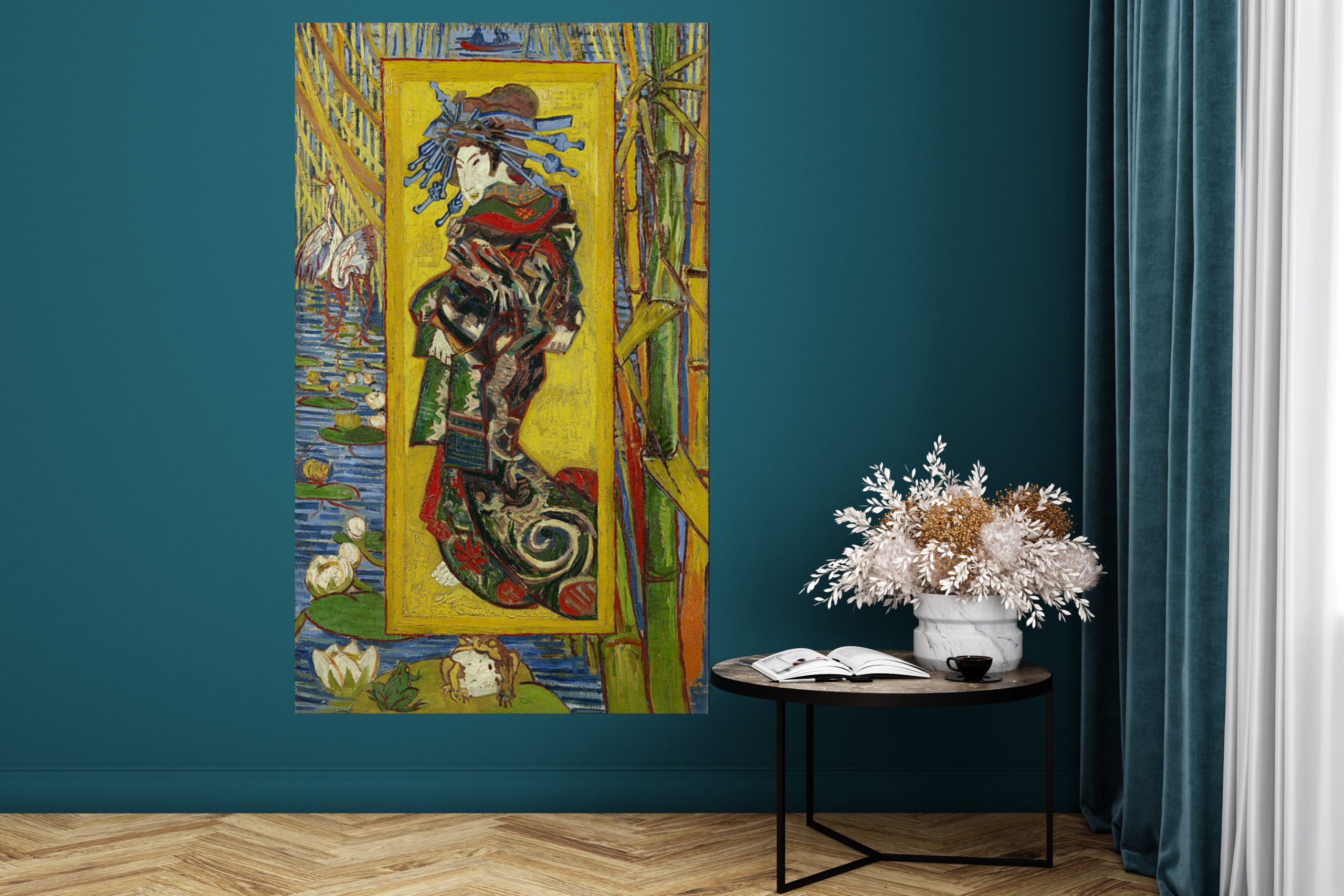
When Vincent van Gogh painted The Courtesan in 1887, he was not merely copying a Japanese print—he was reinventing himself. Paris had exposed him to a new visual language: the bold lines, flattened spaces, and vibrant colors of Japanese ukiyo‑e. For Van Gogh, these prints were not exotic curiosities; they were revelations. The Courtesan stands as one of the clearest expressions of that revelation, a moment when he allowed Japanese aesthetics to reshape his own artistic identity.
A Painting Born from a Magazine Cover
The source of the image is surprisingly humble. Van Gogh encountered a reproduction of a woodblock print by the Japanese artist Keisai Eisen on the cover of Paris Illustré, a popular magazine. Rather than simply copying it, he transformed it. He enlarged the figure dramatically, intensified the colors, and surrounded the courtesan with a vivid, symbolic landscape of frogs, cranes, and bamboo—motifs drawn from Japanese folklore and his own imagination.
This act of translation—from print to painting, from Japan to Paris, from Eisen to Van Gogh—reveals his fascination with cultural hybridity. He wasn’t imitating; he was absorbing, digesting, and re‑expressing.
A Study in Color and Line
Van Gogh’s version is striking for its chromatic boldness. The courtesan’s kimono glows with saturated yellows and greens, while her face is framed by thick, assertive outlines. These choices reflect his belief that Japanese art offered a purer, more direct relationship with nature and emotion.
- Flat planes of color replace Western modeling and shadow.
- Decorative patterning becomes a structural force.
- Contour lines take on expressive weight.
In this sense, The Courtesan is not just a homage—it is a manifesto. Van Gogh is declaring his allegiance to a new visual world.
The Border: A World of Symbols
One of the most fascinating aspects of the painting is the border Van Gogh adds around the central figure. It is a collage of Japanese‑inspired imagery:
- Frogs—often associated with water, transformation, and humor in Japanese folklore.
- Cranes—symbols of longevity and good fortune.
- Bamboo—a sign of resilience and flexibility.
These motifs do not appear in Eisen’s original print. They are Van Gogh’s imaginative bridge between cultures, a way of situating the courtesan in a mythic, dreamlike environment. The border also reveals his instinct for narrative: he is not content with a single figure; he wants a world.
Japonisme and the Parisian Moment
In the 1880s, Paris was enthralled by Japonisme—the wave of enthusiasm for Japanese art that reshaped European aesthetics. Monet, Degas, Toulouse‑Lautrec, and many others collected prints and borrowed their compositional strategies.
But Van Gogh’s engagement was unusually intense. He saw in Japanese art a spiritual clarity, a harmony between humans and nature that he felt Europe had lost. In letters to his brother Theo, he described Japanese artists as “cheerful and happy,” living in a world of sunlight and simplicity. The Courtesan is his attempt to inhabit that world, if only for a moment.
A Prelude to Arles
Only a year after painting The Courtesan, Van Gogh left Paris for Arles, seeking the “Japan of the South.” The painting thus becomes a precursor to his later work: the bold outlines, the saturated palette, the decorative surfaces—all would flourish in Arles and beyond.
In this sense, The Courtesan is not an isolated experiment but a turning point. It marks the moment when Van Gogh’s style begins to crystallize into the language we now recognize as unmistakably his.
Why the Painting Matters Today
The Courtesan invites us to reconsider Van Gogh not only as a tormented genius but as a cultural mediator—an artist deeply attuned to global influences. It shows him as a student of the world, eager to learn from traditions far beyond Europe.
The painting also resonates with contemporary conversations about cultural exchange, appropriation, and artistic dialogue. Van Gogh’s approach—respectful, imaginative, transformative—offers a model of how artists can engage with other cultures without erasing their origins.